

The purpose of Breaking Consensus is to think more critically and find ways to justify our beliefs rather than holding them dogmatically. However, reason, like anything else, can become too much of a good thing. We can end up paralyzed by overthinking, we can fall in a spiral of anxiety about our past, and we can lose friends by constantly engaging them in obsessive philosophical discussions (sad but true!).
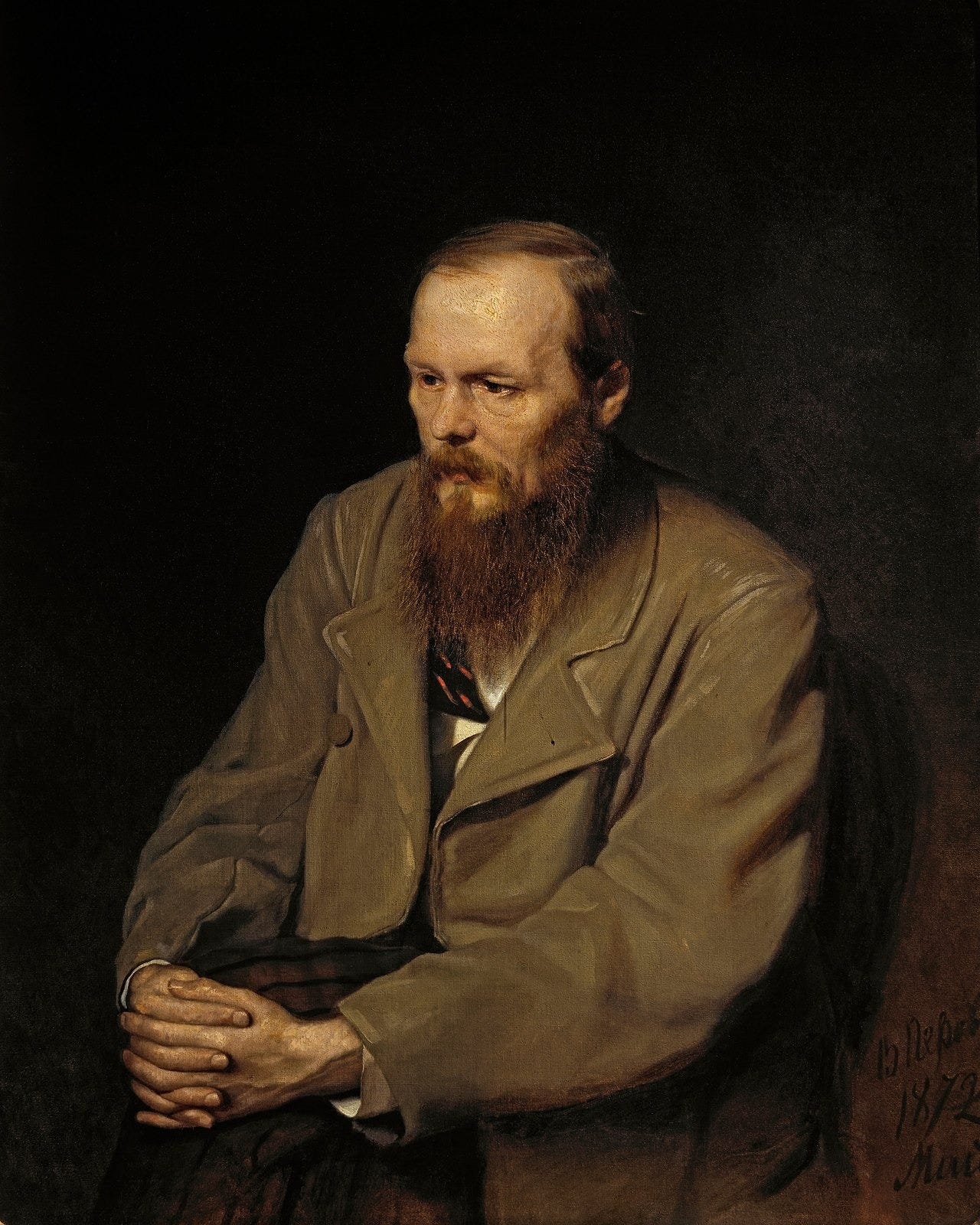
Dostoyevsky warned us of those dangers through some of his characters more than a century ago. He has been part of the turn to psychology in literature, inspiring thinkers such as Sigmund Freud and Nietzsche to investigate further the complexities of our minds. In this essay, I review 5 of Dostoyevsky’s characters and how reason — our only tool to make sense of the world — turned against them.
Minor spoilers alert: the information I provide on the characters are minor spoilers which take place at the beginning of the novels, but some of my interpretation of the stories might remove some of the magic of discovering themes for yourself during the reading of the book. I ensured that those micro-spoilers are contained in their own section, so you can simply skip the ones you haven’t read yet to avoid any inconvenience.
Crime and Punishment: Raskolnikov
Raskolnikov is a dropout student who feels pressured to succeed in life. This weight is imposed on him by the expectations of his family, their sacrificing themselves in order for him to go to university, and — indirectly — their hope of getting his financial support in the future. He lives in St. Petersburg, far away from his native town in the countryside, and is surrounded by the city life — violence, drunkenness, modern wilderness. Slowly, he isolates himself from his peers and neighbors, and spends his days reflecting in his dark, claustrophobic room. Raskolnikov is intelligent, and he starts spinning ideas through his mind, like a spider spreading his web around itself — building a defense that, paradoxically, seals off all possible avenues of escape.
Even though the expectations of others are weighty, his own are crushing. His ambition is to be an extraordinary man — a Napoleon, one who takes what he wants, flying over morals and laws. As time goes by, his abstract idea takes form to the point of becoming logical and justified. Indeed, an extraordinary man benefits society. Who is responsible for the progress of our civilization: the ignorant drunkard or the genius? What is the value of the life of the lowest kind? Motivated by utilitarian ideas (what is good is what maximizes the utility — or overall ‘pleasure’ — of society as a whole rather than the individual), Raskolnikov comes up with the plan to murder Alyona Ivanovna, a pawnbroker despised by most, and use the loot for the benefit of society; while simultaneously confirming his status of extraordinary man — murder as a litmus test.
Notes from Underground: Protagonist
The protagonist of this novel is a spiteful man who lives isolated from society and basks in his own thoughts. His experience with others has developed in him a hate of humanity, and he is torn between this feeling and a social need of others that he cannot shake away. At the beginning of the novel, we discover the man through his notebook, where he addresses a non-existent audience and yet feels the need to justify his opinions. Similarly to Raskolnikov, he has absorbed contemporary ideas and sat in his room running a dialectic with himself.
More than a decade passes between the writing of the notes and the events counted in the second part of the book, yet nothing has changed. Most probably, the characters who participated in those events have long forgotten about it; they carried on with their lives without looking back. But the man is still in his room, considering every detail, reliving in shame his behavior as if it was only yesterday. Tellingly, he recalls the story of being moved away by someone in a bar, calmly yet without even considering him. For days, the man eats himself away, wondering how he missed the opportunity to complain about it, to revolt and fight for his own dignity. He is ashamed of the cowardly way he acted, and promises himself to stand up for himself at the next opportunity. Worse than this, he actually tracks his target, finds out where he lives, observes him to understand his routine and — finally — comes up with the plan of refraining from moving away from his path the next time they cross. For days on, he throws himself in the direction of the other, building his mental strength to avoid swerving away. But he can’t. Each time, his instinct takes over and forces him to avoid the collision. After trying forever, he finally gives up, and involuntarily runs into him. But the ‘victim’ is deep in thought and fails to grasp the situation, continuing his walk as if nothing happened.
The Double: Mr. Golyadkin
Mr. Golyadkin is a minor civil servant part of the Russian imperial bureaucracy doing routine administrative work. One of his most visible traits is his obsession with social status: appearances and ‘busyness’ (in its literal meaning) is all that matters. Clearly, he wished that his situation was better than it is. In his free time, he negotiates the price of furniture he doesn’t have the means to buy in the hope that others will perceive him as a rich and lavish person. Similarly, he exchanges his large bills for smaller ones so that his wallet feels and looks bigger in his pocket.
Unfortunately, others are not duped and see his performance for what it is. Junior employees mock him, his own servant has nothing but contempt for him and colleagues fail to acknowledge his presence. Like many Dostoyevskian characters, he turns to his own mind: he creates a story and sets himself against the others; contrary to them, he doesn’t wear a mask, he says things as they are, he is honest. Interestingly, those fictions constantly underline a recurring theme: he wants to be the savior and to finally be recognized as the hero he has always been. He fantasizes about how he would save the day if the chandelier would fall to the ground during a ball, and how he would sweep away the woman threatened to be crushed and save her life. Again, he is the drop of morality and heroism in a sea of corruption. As the story progresses, his mental load becomes heavier. When the opportunity presents itself, he decides to open up and share his private thoughts with someone special: a man who ran into him in the street and surprisingly resembles him — his double.
Another Man’s Wife and a Husband Under the Bed: Ivan Andreevich
Ivan Andreevich is a married man convinced that his wife is being unfaithful. Even though he doesn’t have the slightest evidence for it, he becomes overcome by jealousy and pictures how his wife might betray him. His reflections spiral out of control and motivate him to spy on her, putting himself in situations where he must explain to others his behavior and forcing him to confront his own shame and mania. Instead of being led to the confirmation of his presuppositions, he finds himself in farcical and humiliating situations, and ends up hiding from the husband of another woman by lying under their bed.
White Nights: Protagonist
The protagonist of White Nights is a lonely man who turns to his imagination as a way to escape his reality. Being too shy to strike a conversation with others, he paints them as novelistic characters and comes up with what their stories must be like. He develops one-way relations with them, expecting to run into them at some time and place of the day, participating in their routine unbeknownst to them. As the creative director of his own life, he goes as far as befriending houses and striking up conversations with them. All events captured by his attention are transformed into a romance, until he cannot escape it anymore. His capacity to focus on the real drifts away and his escapism turns into a prison. He himself gives up on the hope of experiencing the raw content of the world and exchanges it for an abstract idea.
Is Reason Doomed?
Thinking is extremely useful, but it can turn against itself like a snake biting his own tail if we allow it. Reason, thought and fiction should be a support to our life rather than a substitution. Too often, we get stuck in ruminating the past or fantasizing about how our life will turn around thanks to an event which will show everyone that we were actually an undercover hero all along — just like Mr. Golyadkin. Or similarly to the Man from the Notes, we might spend years resenting someone for something they did not even know about — they might even be unaware of our existence.
Those fictitious stories are attractive, they are mental black holes which can swallow us entirely if we get too close to them. But life is not a novel or a cliché movie — it is the fundamental substance they are built upon. The risk is that certain stories we come up with isolate us from the world. They can create divisions: we might feel superior to others, or associate ourselves to a group identity and resent ‘them’. Without even realizing it, our thinking becomes repetitive and unidirectional. We pound on all problems with the same old hammer, we uncritically assign the cause of all our pains to the same entity. Our reasoning, which used to be so versatile and colorful, becomes monotonic and boring. Most of our time is spent in our heads, looking at the past for excuses and at the future in spite.
Dostoyevsky reminds us about the risk of creating our own echo chambers. To break them, we must start by avoiding isolating ourselves: we must seek companionship, meet people with fundamentally opposed views and backgrounds, teach our ego to stop clinging to our opinions and hear those of others. Failing this, we are bound to become a caricature of a novelist from the 19th century — a mere fiction.